



Home | SOC | Workshop Rationale | About WST | Programme | Registration
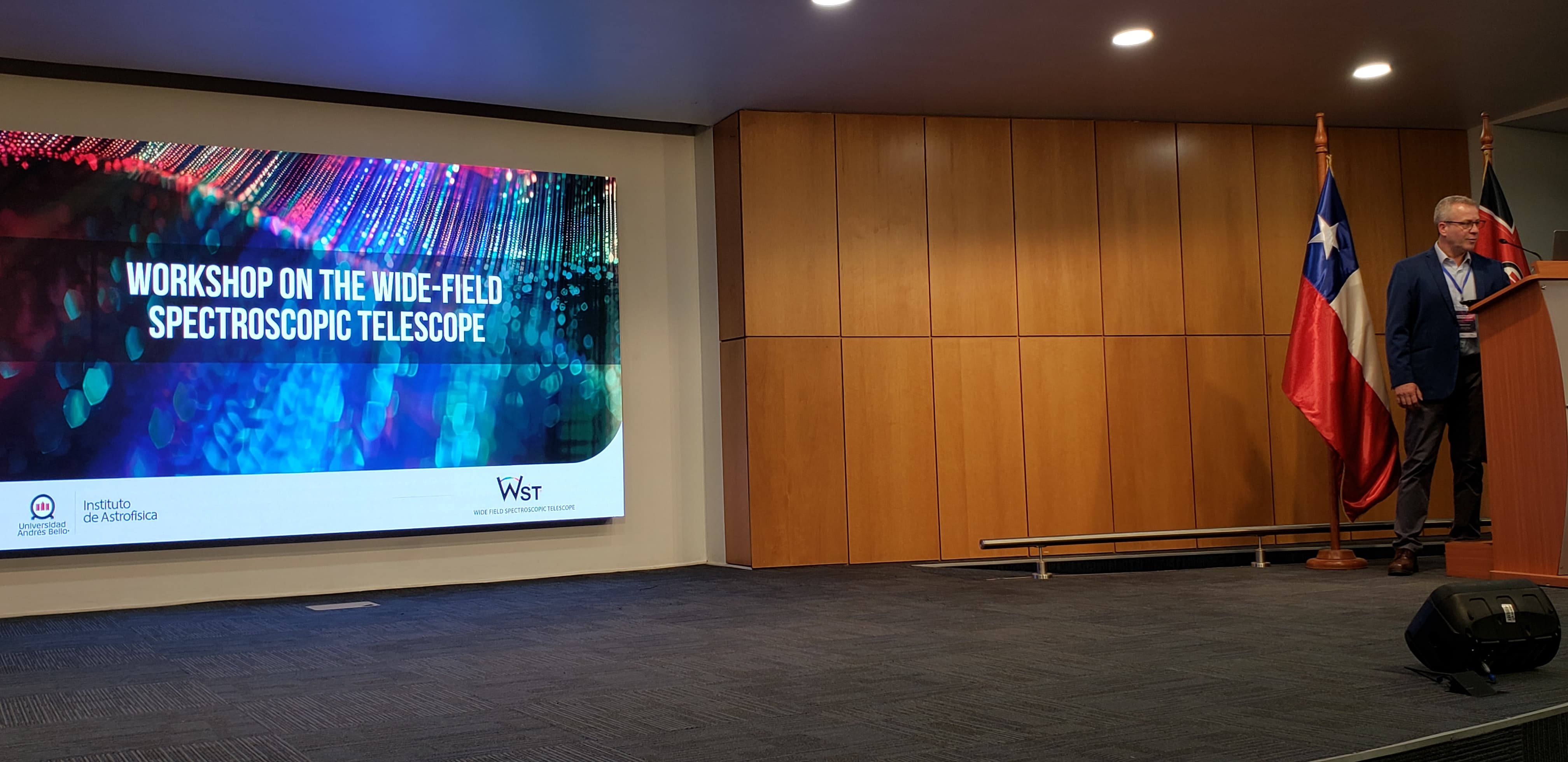
Workshop on the Wide-field Spectroscopic Telescope
15–16 December 2025 | Universidad Andrés Bello, Santiago, Chile

Scientific Organizing Committee
- Vincenzo Mainieri (ESO Garching, co-Chair)
- Steffen Mieske (ESO Chile, co-Chair)
- Roland Bacon (Observatoire de Lyon)
- Timo Anguita (UNAB, Chile)
- Patricia Arévalo (U. Valparaíso, Chile)
- Ricardo Demarco (UNAB, Chile)
- Matías Gómez (UNAB, Chile)
- Pascale Hibon (ESO Chile)
- Paula Jofré (UDP, Chile)
- Paulina Lira (UCh, Chile)
- Chiara Mazzuchelli (UDP, Chile)
- Sofia Randich (INAF, Italy)
- Paula Sanchez (ESO Garching)
- Manuela Zoccali (PUC, Chile)
Workshop Rationale
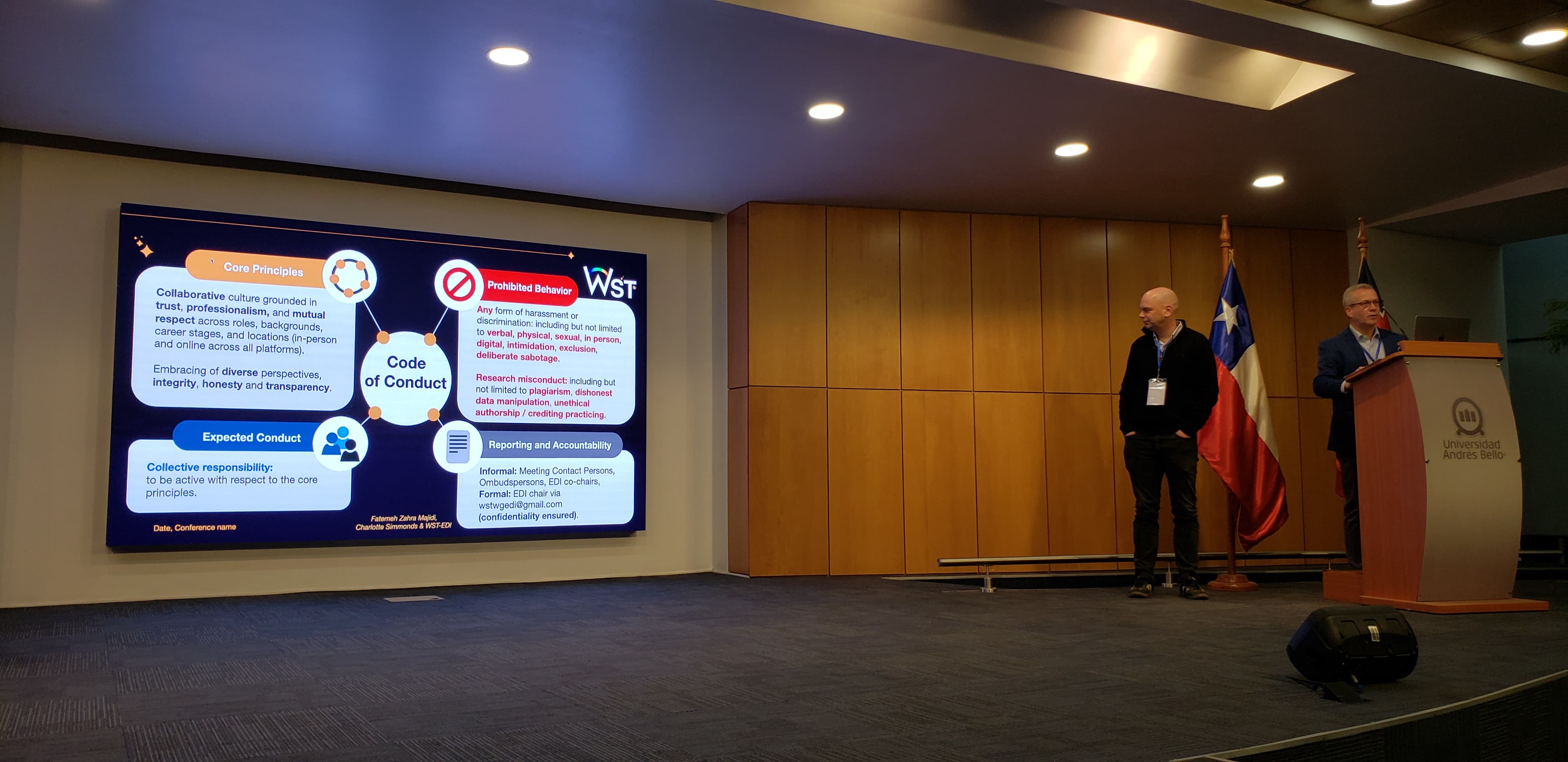
The aim of this workshop is to inform the Chilean astronomical community about the Wide-field Spectroscopic Telescope (WST), which is foreseen to be hosted in Chile, and to involve Chilean colleagues in further shaping what will be a key facility in the 2040s.
This workshop will serve to:
- Inform the broader Chilean community about WST and its unique capabilities, showing its potential for breakthrough science and illustrating current science drivers.
- Stimulate Chilean researchers to join the team and propose new science cases.
- Discuss synergies with upcoming ground- and space-based facilities.
- Explore the challenges of new technologies, big data, and possible upgrades beyond the current baseline design.
We will cover a wide range of topics, including:
- Cosmology
- Galaxy formation, evolution, and chemical enrichment
- The Milky Way, Local Group galaxies, and galactic archaeology
- The formation of stars and planetary systems
- The variable Universe
- Multi-messenger astrophysics
- Synergies with ground- and space-based facilities in Chile
- Big data challenges
- New technologies
The deadline to register with contributed talks is September 30, 2025.
About WST
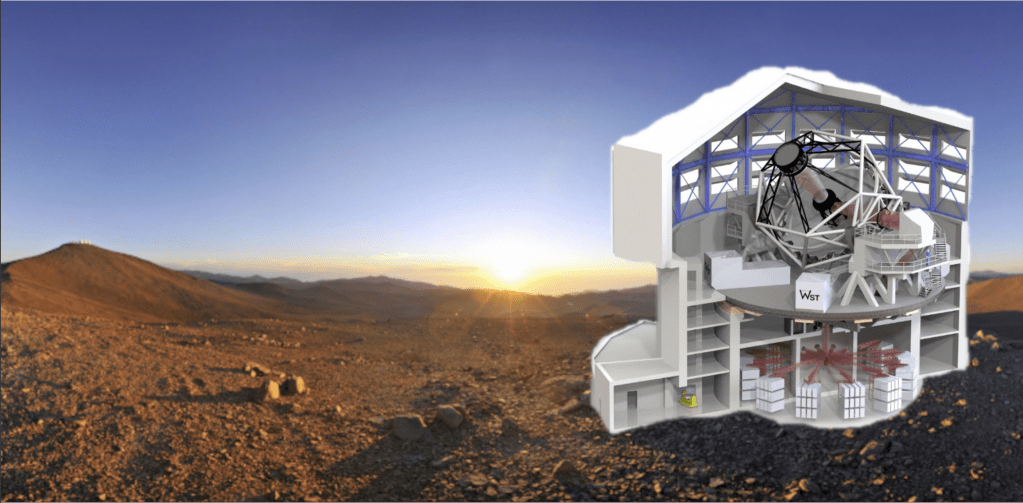
Wide-field Spectroscopic Telescope (WST) is a bold and ambitious facility designed for large-scale spectroscopic surveys. Its current baseline features a 12-meter primary mirror and the simultaneous operation of two major instruments:
- A wide-field, high-multiplex multi-object spectrograph (MOS) covering 3 square degrees, capable of observing up to 30,000 objects in low-resolution mode and 2,000 in high-resolution mode.
- A giant panoramic integral field spectrograph (IFS) with a 3 x 3 arcminute field of view.
These capabilities place WST far ahead of current and planned spectroscopic facilities, both in multi-object and integral field spectroscopy. It will fill a vital gap in the global astronomical landscape, enabling groundbreaking science in key areas such as:
- Cosmology
- Galaxy formation, evolution, and chemical enrichment — including detailed studies of our Milky Way
- The formation of stars and planetary systems
- Time-domain and multi-messenger astrophysics
The WST consortium has recently secured funding through the Horizon Europe program to carry out a comprehensive three-year concept study. The goal is to propose WST to ESO as the next major facility following the completion of the Extremely Large Telescope (ELT). This proposal is expected to be submitted by June 2027, within the scope of ESO’s Expanding Horizons initiative (see https://next.eso.org/).
Workshop Programme
Two days of scientific presentations and discussion: 15 & 16 December 2025
REGISTRATION: Closed
Directions:
Universidad Andres Bello,
Fernandez Concha 700
Las Condes, Santiago, RM
Chile
 astrounab.cl